Local Color

Around Fairbanks, Irene was a familiar sight–a terribly scarred woman in layers of tattered clothes who walked miles a day and loudly greeted friends with great warmth. Year after year she was both loved and feared, cussing like a sailor, drinking like a college kid, and hoarding her treasures at the junkyard she called home. Ask any long-timer. They’ll have an Irene story. She was uniquely Alaskan, uniquely Fairbanksan. She was watched over, invited in for meals, driven to appointments, and helped financially by pioneer families and newcomers alike, people who did not draw attention to their generosity. Irene was not just any bag lady. She was our bag lady.

In 1913, the view across the Chena River included newspaper offices, a door factory, Immaculate Conception Catholic Church, and St. Joseph’s Hospital. (Library of Congress photo)
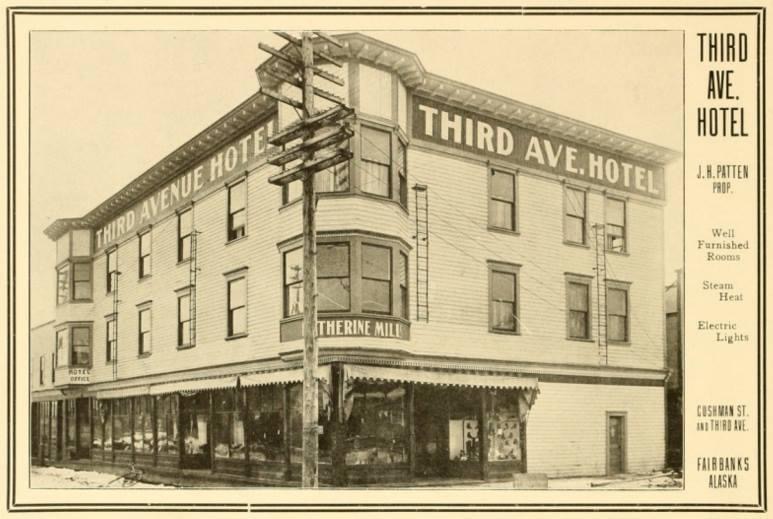
a-Third-Ave-Hotel-newspaper-ad-JH-Patten-prop.jpg

Irene Sherman’s roots in the Golden Heart City were deep. Her parents and maternal grandparents were among the earliest citizens of the young gold camp called Fairbanks. Grandmother Minnie Eckert had moved north from Seattle in 1905 after a divorce, and brought two teenaged children with her. One of them was Irene’s mother, Agnes Eckert. In 1908, Minnie remarried John Patten, who owned and operated the lavish Third Avenue Hotel along Cushman Street between Third and Fourth, and it was there in the hotel parlor that in 1910 daughter Agnes married James Paul (or J. P.) Sherman.  He had stampeded to Fairbanks when news of gold discovery took off, but he chose to trap fur-bearing animals and mine for gold in the Bonnifield District, south of the Tanana River and north of the Alaska Range foothills.

And then at age five . . .
1974 March 22_ All-Alaska Weekly story on 'Packsack Annie'

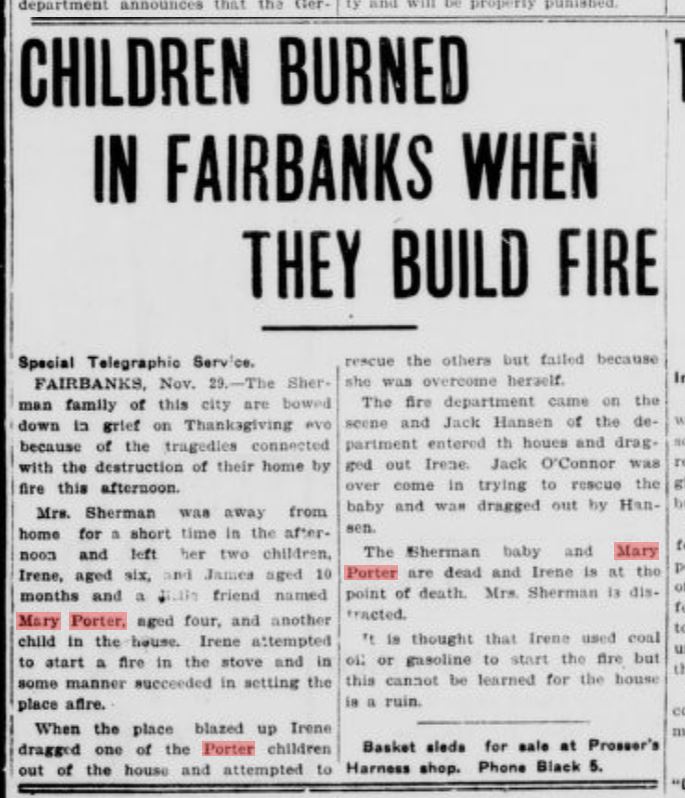
J. P. was out of town in the days before Thanksgiving 1916 when a raging cabin fire in Fairbanks nearly killed Irene and took the lives of her nine-month-old baby brother, James, and a neighbor girl named Mary Porter who’d come over to play. The children had been left alone while Irene’s mother Agnes went out socializing for the day. Irene alone survived, but would spend ten years in the Seattle area undergoing further medical treatment and bouncing among foster homes before landing in a convent school. She would not return to Alaska until 1929. The toll of her early childhood trauma was immeasurable.


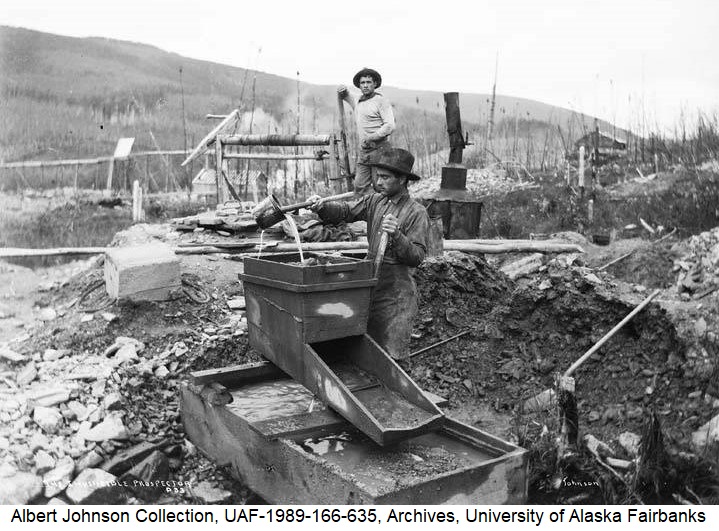
Interior Alaska gold miners with a rocker box. Albert Johnson Collection, UAF Archives
Though not pictured here, Irene’s father, J. P. Sherman, used these mining methods on his claims in the Bonnifield District, including using a rocker box to process his gold.
St. Matthew's Hospital, where Irene was born on January 29, 1911.
Irene was born on January 29, 1911, at St. Matthew’s Hospital, which once stood next to the log church by the same name. (UAF Archives; Albert Johnson Collection; 1989-166-170)
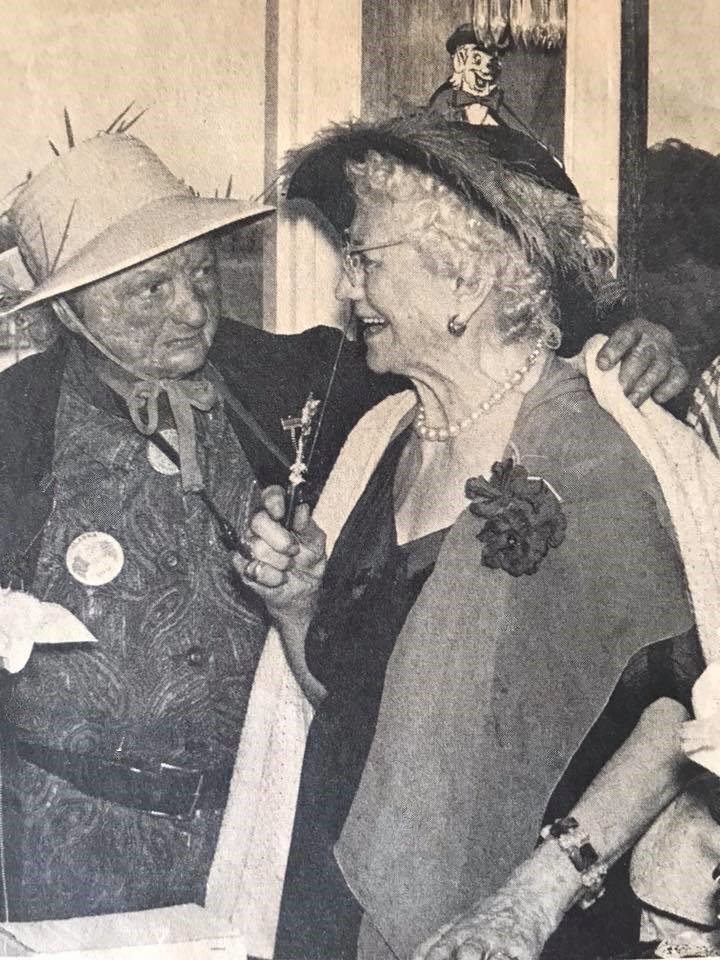
1969 May-20 Irene greets fellow pioneer Eva McGown at Eva's 86th birthday party aboard the riverboat Nenana.
On May 20, 1969, Irene greeted fellow pioneer Eva McGown at Eva’s birthday party aboard the riverboat Nenana in Alaskaland. (News-Miner Archives)
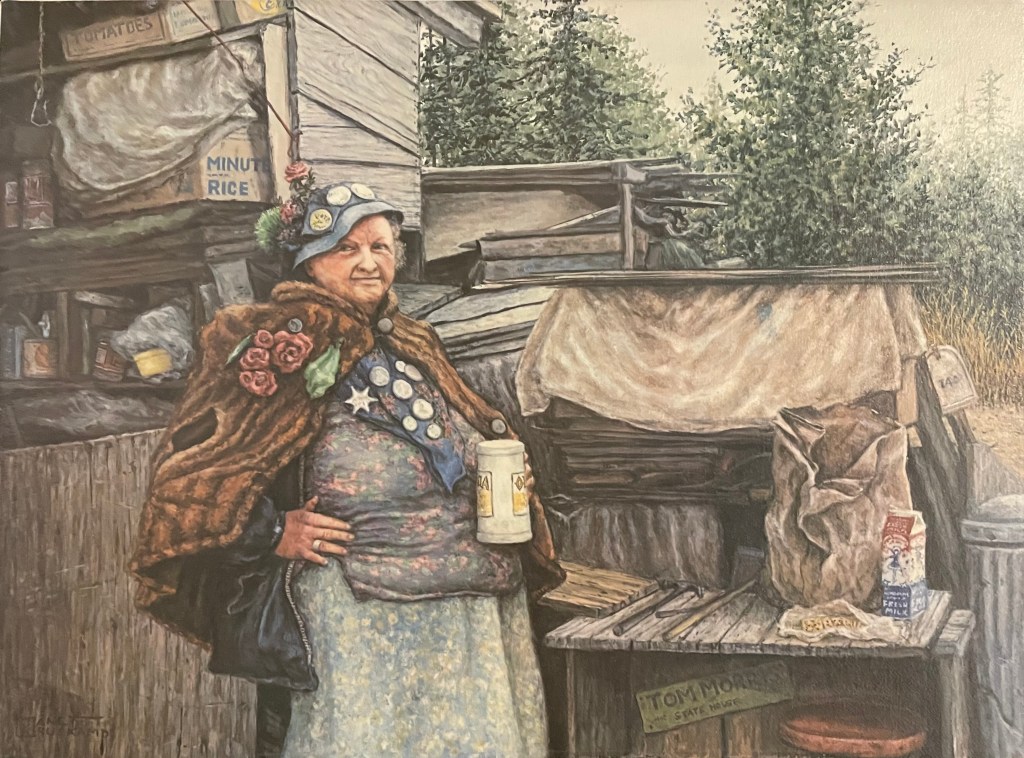
"Miss Irene" painting by Janet Kruskamp, 1976
Titled “Miss Irene,” this 1976 painting by California artist Janet Kruskamp was purchased by Ken and Ida Ryfogel of Fairbanks. Print sales benefitted the hospital’s burn center.
1982 July; New-Miner photo by Eric Muehling
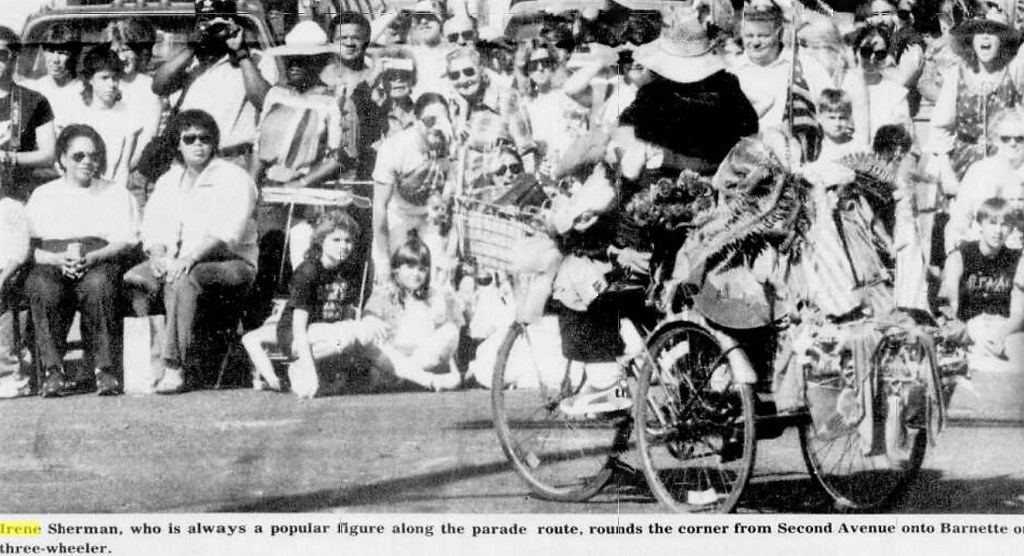
News-Miner photographer Eric Muehling captured this image of Irene pedaling her three-wheeler in the 1982 Golden Days Grande Parade.
1985 July News-Miner coverage of the parade; Charles Mason photo
1985 News-Miner photo by Charles Mason
1973 July. Irene in the Golden-Days-Parade
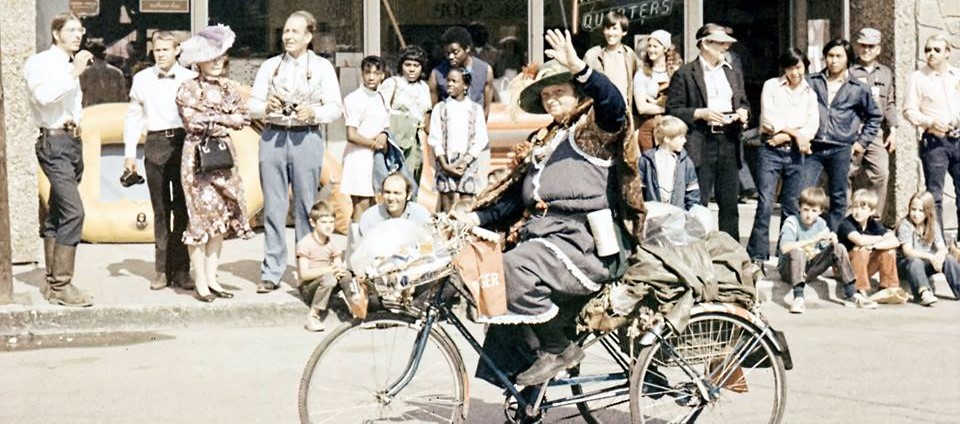
In 1973, Irene wore her mink stole over a dress over a shirt and pants for the parade. She was never without a hat of her special choosing.
Irene entering her "wig-wam"; Erik Hill photo, Anchorage Daily News
After spending a day with Irene around town in 1988, Anchorage Daily News photographer Erik Hill paused for one more shot as the Queen climbed over debris at her “front door.”
Irene-Sherman-died-in-1995-and-was-the-last-casket-burial-in-the-Clay-Street-Cemetery_-Tricia-Brown-photo-rotated.jpg
With Irene’s death in 1995, the City of Fairbanks honored her by re-opening the pioneer Clay Street Cemetery for a last casket burial. Irene’s Denali Center caregivers ensured that Irene wore layers of clothes and a hat, and, of course, her beer stein. (Tricia Brown photo)